

A 2026 National Storytelling Festival Preview
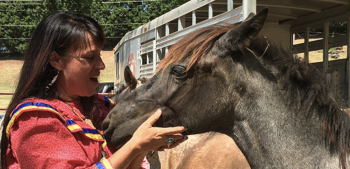 Amy Bluemel saw the world at a very young age. Her father’s work on military bases moved the family to spots around the globe, including Turkey, Germany, Japan, and Scotland. Then there was Texas, where they typically landed for a few years between gigs.
“My father was adamant that we learned the culture in every country,” she says. “It was a great life and really gave me a much broader perspective on the world. He used to say the base is Little America and you have the rest of your life to live in America. You won’t get this opportunity again.”
As a kid, her father’s cultural immersion ambitions felt like a drag. But as an adult looking back, Bluemel sees those years as the start of something epic.
By the time she was a teenager, she was fluent in German and Turkish. She learned how to blend in, and she started collecting stories wherever she went. In Turkey, there were the hodja stories, witty tales about wise men and fools. In Europe, she heard about damsels and dragons. And in Okinawa, she learned classic Japanese folk lore.
Ironically, when she became a young adult, Bluemel realized that one of the few cultures she knew nothing about was her own. As a member of Chickasaw Nation (on her mom’s side), she grew up with little connection to tribal culture. She had learned so many stories in so many places — how could she not have heard learned her own?
Troubled by her ignorance about her family’s history, Bluemel and her mother frequently traveled to Oklahoma to connect (or, in her mother’s case, reconnect) with other tribe members, traditional dancing, and other Native American rites. After a lifetime of travel, Bluemel felt immediately at home. She quickly picked up the ceremonial style known as stomp dance, a sacred social ritual that she has since taught around the country. As one of the oldest dances on the continent, if not the world, every stomp dance is a piece of living history.
While Bluemel doesn’t dance as part of her storytelling sets (the style requires many people, men and women), she’ll share many elements of her heritage as a featured teller at the National Storytelling Festival. In a year that is widely celebrated as the 250th birthday of the United States, she brings an interesting and needed perspective. “The stories that I tell are older than that,” she says. “People talk about this country like it started on that day, exactly 250 years ago. But there was a lot of history going on prior to that.”
Very often, she shares stories and episodes from Native American history that most people in her audiences don’t know. As someone who didn’t learn much about it until her twenties, Bluemel doesn’t feel critical of anyone’s ignorance. “You can’t really blame people for not knowing what they’ve never seen,” she says, noting that many Indians were forcibly displaced and have therefore remained out of the public eye. And anyway her dad’s side of the family has a pilgrim in its lineage, so her ancestral relationship to the history is more complicated than you might imagine.
Being a cultural ambassador of sorts comes naturally to Bluemel, who begins every performance with a Chickasaw greeting. “I’ll say, hey, you’ve probably learned your first Native word from me!” she says. “We all speak Native languages all the time, just not necessarily well. If you’ve ever said ‘Tennessee,’ you’ve said a Native word. “If you’ve ever said Ohio or Kentucky, you’ve said a Native word.”
She doesn’t mind explaining, for instance, that Native American regalia is not a costume. When you wear a costume, you’re pretending to be someone else. When you wear regalia, you’re representing. She thinks a lot of cultural misunderstandings come from a simple lack of clarity around core concepts, and that’s a problem that’s easily fixed.
“I think that’s my whole gig, being an educator,” she says. “When you leave my performance, I want you to have a good time. I want you to perhaps have been moved. And I want you to walk away and go, wow, I never knew. Or maybe: can you believe this is how that happened?
“In the past, in my family there was a lot of trauma that runs downhill. And I kind of feel like it’s my job to be proud for people who couldn’t be.”
Amy is the latest featured teller in our New Voice series, a preview of the 53rd Annual National Storytelling Festival. You can read our profile of Kelly Campos here. Join us for the Festival in Jonesborough October 2-4, 2026.